
Ultimate Guide to Sensory Rooms
What Is A Sensory Room?
Sensory Rooms are safe and controlled environments that provide sensory stimulation to those who need it.
They offer a secure space for relaxation, exploration, and independence, fostering a sense of self-confidence, imagination, and positivity in users with special needs and disabilities.
Who Can Use A Sensory Room?
Sensory rooms are typically used by people with disabilities, autism and sensory processing problems, who may struggle to regulate their senses in everyday environments.
Although almost anyone who’s looking for a safe space to chill out can benefit from sensory stimulation. We’ve been known to take a break from the office to spend some time inside our Sensory Trailer!
How Do Sensory Rooms Help People With Special Needs?
Sensory Rooms support people’s senses, moods and development. Although their benefits are deeper than a simple sensory space. You might not know that there are wider benefits.
-
Sensory Regulation
People with sensory processing problems will usually find themselves over- or under-stimulated (or both at the same time!). This means that they’re either getting too much or too little sensory stimulation from the environments around them.
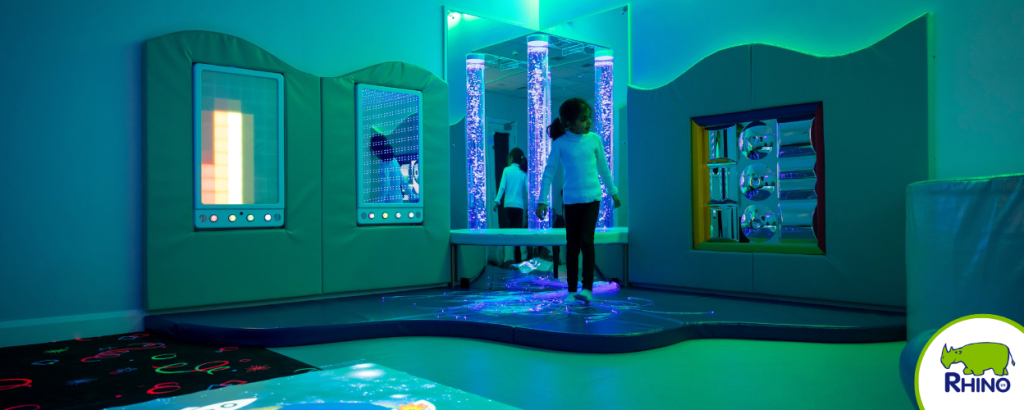
Sensory rooms provide controlled environments where individuals can effectively balance their sensory systems. For example, they can passively sit amongst soft pillows and watch the bubbles slowly rise through a Bubble Tube, or they can actively interact with an interactive wall panel, engaging with its bright colours and sounds.
What’s important is that users have the autonomy to control their own sensory experience.
-
Improved Focus & Emotional Regulation
By giving the brain the sensory input it needs, sensory rooms can help individuals:
- Self-soothe and control their emotions (including reducing meltdowns)
- Improve their focus and readiness for learning or tasks
- Manage their anxiety or agitation
-
Communication & Engagement
Sensory rooms can be used to encourage non-verbal communication, decision-making, and interaction in a low-pressure way. By promoting independence, sensory exploration and play, individuals are softly encouraged to build connections to their peers, teachers and families.
They’re especially useful spaces for people who find traditional social environments overwhelming, like in schools, hospitals or busy football stadiums.
-
Motor Skills & Body Awareness
Specialist Sensory Integration Rooms are designed to support and develop proprioceptive (bodily awareness) and vestibular (balance) systems. Occupational therapists typically use these therapeutic spaces to help individuals nurture their coordination, balance, and spatial awareness skills.
Key resources like Squeeze Machines and Weighted Blankets provide deep-pressure stimulation that centres individuals, calming nervous systems, and helping them to feel more comfortable in their body. Whilst Swings and Balance Boards challenge vestibular senses, whilst developing balance and coordination skills.
Sensory Integration therapy is especially helpful for individuals who struggle with motor planning and everyday movements.
-
A Safe Space for Everyone
At their core, sensory rooms provide comfort, autonomy, and dignity. They’re designed with individual needs in mind, making them a space where people can be themselves without judgment.

Different Types of Sensory Rooms
Sensory rooms come in all shapes and sizes and can be used to help people with a wide range of needs and abilities. From adventurous Soft Play Rooms, to out-of-this-world Immersive Rooms, and classic cosy sensory spaces.
Each sensory room type has a distinct personality, specially tailored to support a specific kind of sensory need.
For example, Soft Play Rooms are great for kids who need to burn off excess energy. Soft, colourful padding and a selection of adventurous obstacles mean they can zoom, jump, climb and actively develop their motor senses.
Immersive Rooms are wonderful spaces that encompass all your senses. Themed lighting, interactive projectors, and immersive soundscapes transport you away from your environment to an imaginative sensory world.
So, when it comes to choosing your sensory room type it’s important that you think about who’s going to be using it, what their needs are, and how you can best support them.
Find out more about each of our sensory rooms.

How to Create Your Own Sensory Room
It might sound simple, but get in touch with our expert sensory team! They have the expertise and experience to craft a bespoke sensory space that will perfectly suit your needs and requirements.
After a preliminary discovery call, they’ll put together your sensory room design proposal, which will include 3d room images, a list of the included products, and a full costing of the room, including installation and post-sales support.
But if you don’t have the budget or space for your own sensory room, don’t worry! There’s still lots of ways that you can craft your own sensory space. Find out more about creating a sensory room on a budget: https://www.rhinouk.com/how-to-make-a-sensory-room-on-a-budget/
Or how to create your own sensory den, on our blog!
Speak to an expert